Managers & executives
For leaders who see efficiency, growth and complexity quietly narrowing the company's options.
A working method for managers, founders and investors who need to spot the dependency, the complexity and the habit that narrow their options, and act before correction gets expensive.
Strategic Calibration Mode shows how to tell a real shift from noise, test big moves before committing, and stress-test the decisions that matter against more than one forecast. Built on five decision vectors, it applies from the boardroom to the portfolio.
The book is not written as motivational strategy theatre. It is for people who have to make coherent decisions under imperfect information, delayed feedback loops and regime shifts — where being approximately right today can still become structurally wrong over time.
For leaders who see efficiency, growth and complexity quietly narrowing the company's options.
For owners making fast commitments, where one dependency or one yes can shape the next decade.
For capital allocators and portfolio decision makers working across cycles, concentration, optionality and drift.
For strategy, transformation and advisory teams, and for MBA and executive education where strategy is taught as system design.
Most failure analysis arrives too late: after the outcome. SCM moves the question upstream. It asks whether decisions remain aligned as markets shift, assumptions age, incentives accumulate and complexity grows faster than control.
Strategic Calibration Mode spans enterprise strategy, capital allocation, sovereign risk and personal decision-making. It draws on cases from Apple and GE to LTCM and Silicon Valley Bank, to show how fragility is produced — and how it can be structurally managed.

“Strategic Calibration Mode […] is a framework that executives, business leaders, and entrepreneurs can immensely benefit from.”
“[…] all these concepts make practical sense in the real world.”
“If you’re in a position to make key decisions or design strategy for your organization, I highly recommend this book.”

This is not a book about winning cycles. It is about surviving enough of them to compound — without letting small strategic misalignments silently become structural fragility.
For decision makers who know that intelligence, data and conviction are not enough when the system itself begins to drift.
A short booklet to see where your decisions and dependencies may be narrowing your options. No sign-up needed. Choose your language below.
Visual summaries and supporting material for the core ideas of Strategic Calibration Mode: structural coherence, decision vectors and strategic drift.
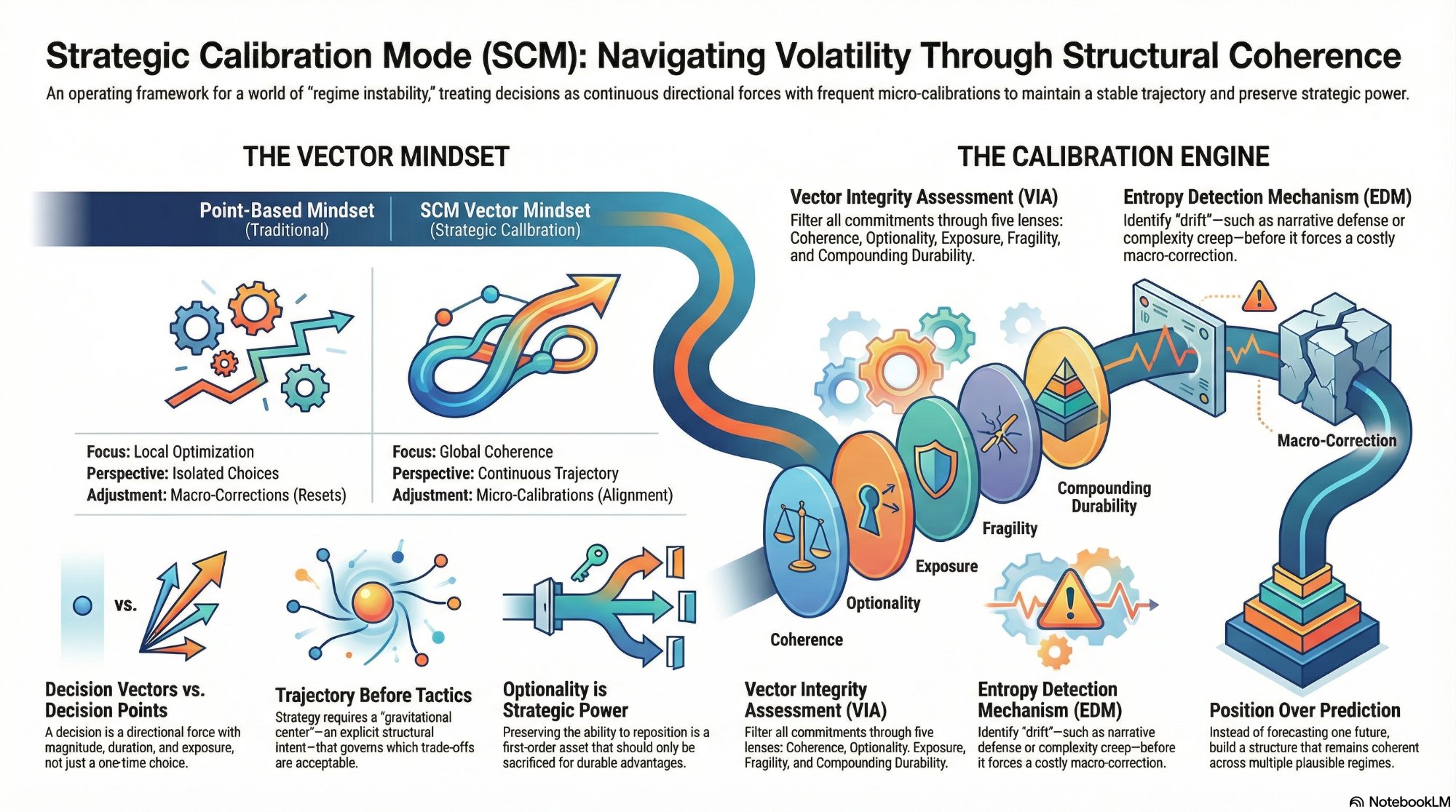
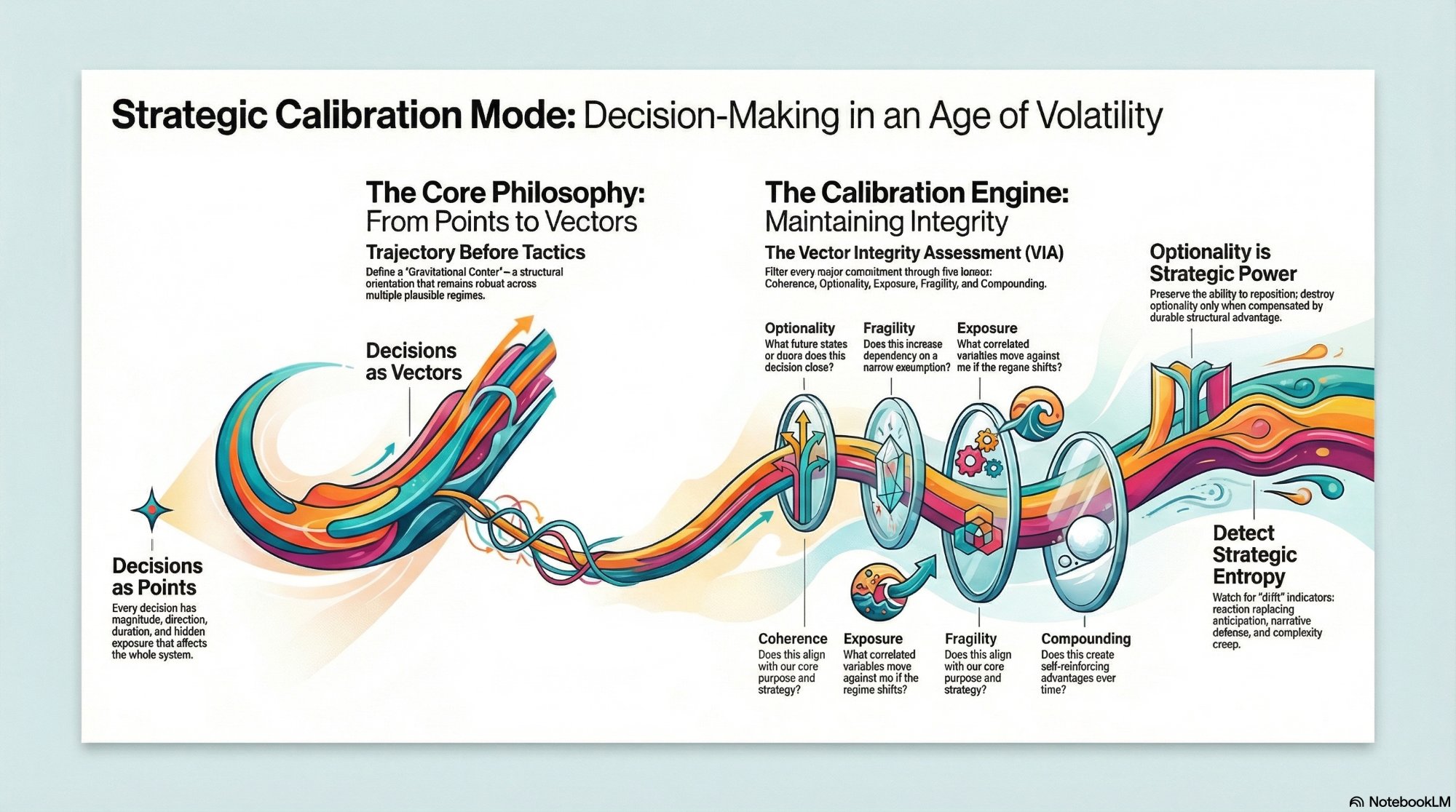
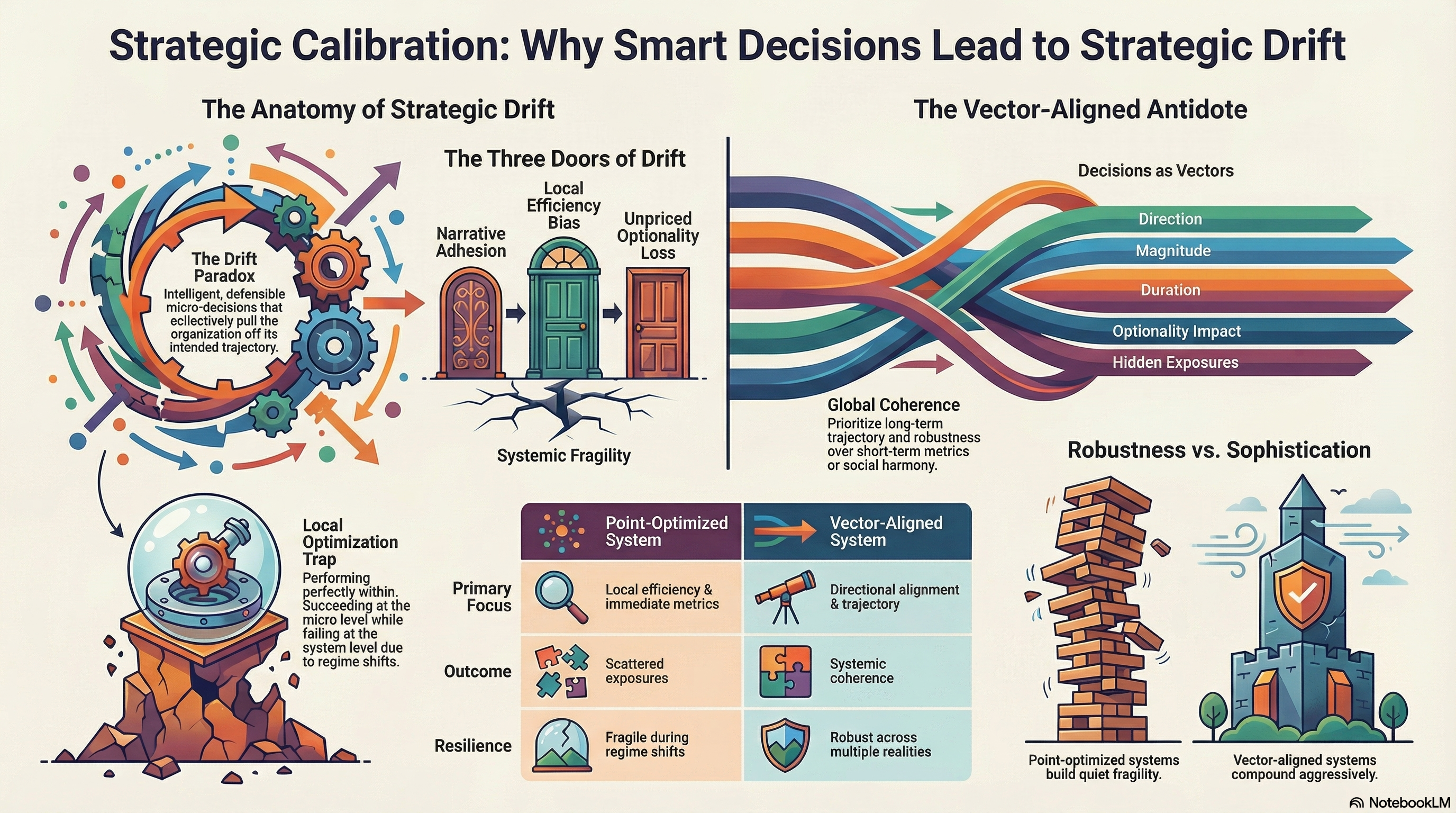
Short video essays and book materials for readers who want the framework before entering the full book.
Essays and articles extending the Strategic Calibration Mode framework across business, investment, and personal decisions.
Your strategy team can tell you exactly what next year looks like. Can they tell you what happens to the business when that picture is wrong?
Read on LinkedIn →The real cost of AI isn't in jobs or productivity. It's in the silent destruction of personal optionality — one painless decision at a time.
Read on LinkedIn →O verdadeiro custo da IA não está nos empregos nem na produtividade. Está na destruição silenciosa da opcionalidade pessoal — uma decisão indolor de cada vez.
Ler no LinkedIn →Strategic Calibration Mode comes from the intersection of audit, risk governance, strategic advisory and long-horizon decision analysis.
Joel Vieira dos Reis writes from the intersection of audit, risk governance, and strategic advisory.
Strategic Calibration Mode is the synthesis of two decades observing how organizations make coherent decisions that quietly point in the wrong direction — and how small misalignments, compounded over time, produce strategic failures that no single decision could have caused alone.
His work focuses on the structural integrity of decision systems: how to keep tactical execution and long-horizon trajectory aligned, especially when feedback loops are slow and outcomes only materialize across cycles.
For book questions, educator copies, workshops, speaking engagements, media or institutional enquiries.
Use this form to reach out directly about the framework, training applications, speaking engagements, media or institutional use.
